Pengaruh Variasi Material Abrasif Sandblasting terhadap Kekuatan Adhesi dan Laju Korosi Lapisan Thermal Spray Aluminium pada Baja ASTM A36

DOI:
https://doi.org/10.32528/jp.v11i1.5629Keywords:
pelapisan; korosi; penyemprotan termal aluminiumAbstract
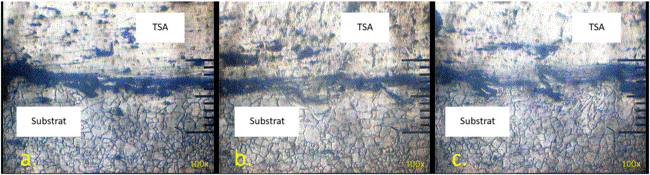
Struktur lepas pantai dari baja karbon sangat rentan terhadap korosi di lingkungan laut. Thermal spray aluminium (TSA) merupakan metode pelapisan yang memberikan perlindungan korosi melalui mekanisme barrier dan perlindungan katodik. Penelitian ini bertujuan mengevaluasi pengaruh variasi material abrasif sandblasting terhadap kekuatan adhesi dan laju korosi lapisan TSA pada baja ASTM A36. Material abrasif yang digunakan adalah pasir garnet (30 mesh dan 60 mesh), steel grit (40 mesh), dan aluminium oxide (16 mesh). Sandblasting dilakukan hingga tingkat kebersihan Sa 2½, kemudian diaplikasikan lapisan TSA dengan ketebalan 200–400 μm. Pengujian meliputi kekuatan adhesi, laju korosi, uji tekuk, dan pengamatan struktur mikro. Hasil menunjukkan steel grit menghasilkan kekasaran tertinggi (79,5 μm), sementara pasir garnet menghasilkan kekuatan adhesi tertinggi (17,92 MPa) namun menunjukkan laju korosi tertinggi (3,9429 mm/tahun) yang diindikasikan berkorelasi dengan tingginya nilai konduktivitas akibat residu garam terlarut pada permukaan. Laju korosi terendah diperoleh pada spesimen steel grit (0,9394 mm/tahun).
References
[1] H. Pratikno, R. D. Mulya, and W. L. Dhanistha, “Analysis of Abrasive Materials dan Air Pressure Variations for Thermal Spray Aluminum Coating on Adhesion Strength and Corrosion Resistance in Seawater Environment,” International Journal of Offshore and Coastal Engineering, vol. 9, no. 1, pp. 1–6, 2025, doi: 10.12962/j225800914.v9i1.4467.
[2] L. Thakur and H. Vasudev, Thermal Spray Coatings. Florida: Taylor & Francis Group, 2021, doi: 10.1201/9781003213185.
[3] M. A. S. Anam, P. Manik, and G. Rindo, “Analisis Pengaruh Material Abrasif Pada Blasting Dengan Variasi Metode Coating Terhadap Prediksi Laju Korosi Dan Daya Rekat Adhesi,” Jurnal Teknik Perkapalan, vol. 12, no. 2, pp. 1–11, 2024, [Online]. Available: https://ejournal3.undip.ac.id/index.php/naval
[4] C. Trijatmiko, H. Pratikno, and A. Purniawan, “Analisa Pengaruh Material Abrasif Pada Blasting Terhadap Kekuatan Lekat Cat dan Ketahanan Korosi di Lingkungan Air Laut,” Jurnal Teknik ITS, vol. Vol. 5, No. 2, 2016, doi: 10.12962/j23373539.v5i2.18090.
[5] M. Ridho Alfaridzi, A. Wibawa, B. Santosa, and W. Amiruddin, “Analisis Pengaruh Salinitas Air dan Material Abrasive Blasting Terhadap Laju Korosi Pada Baja ST 45,” Jurnal Teknik Perkapalan, vol. 13, no. 3, 2025, [Online]. Available: https://ejournal3.undip.ac.id/index.php/naval.
[6] NACE No. 12, “Specification for the Application of Thermal Spray Coating (Metallizing) of Aluminium, Zinc, and Their Alloys and Composites for the Corrosion Protection of Steel,” 2016, NACE International.
[7] ISO 8501-1, “Preparation of Steel Substrates Before Application of Paints and Related Product - Visual Assessment of Surface Cleanliness,” 2007, International Standard Organization.
[8] ISO 8503-2, “Preparation of Steel Substrates Before Application of Paints and Related Products-Surface Roughness Characteristics of Blast-Cleaned Steel Substrates-,” 2012.
[9] ISO 8502-9, Preparation of Steel Substrates Before Application of Paints and Related Products. Tests for the Assessment of Surface Cleanliness. Part 9: Field Method for the Conductometric Determination of Water-Soluble Salts. British Standards Institution, 2020.
[10] ISO 19840, “Paints and Varnishes Corrosion Protection of Steel Structures by Protective Paint Systems Measurement of, and Acceptance Criteria For, the Thickness of Dry Films on Rough Surfaces,” 2012. [Online]. Available: www.iso.org
[11] NORSOK M-501, “Surface Preparation and Protective Coating,” NORSOK, Annex 2A, 2022.
[12] ASTM D 4541, “Test Method for Pull-Off Strength of Coatings Using Portable Adhesion Testers,” Aug. 01, 2017, ASTM International, West Conshohocken, PA. doi: 10.1520/D4541-17.
[13] ASTM G 102, “Standard Practice for Calculation of Corrosion Rates and Related Information from Electrochemical Measurements,” 2015, ASTM International. doi: 10.1520/G0102-89R15E01.
[14] S. Brossard, “Microstructural Analysis Of Thermal Spray Coatings By Electron Microscopy,” 2010. [Online]. Available: https://theses.hal.science/tel-00492966v1, doi: 10.3390/coatings15101216.
[15] C. A. Zimmermann, L. A. D. Koslowski, M. I. S. Araújo, and M. L. L. Silveira, “The influence of soluble salts content on the performance of an epoxy coating system via accelerated corrosion tests,” Revista Materia, vol. 25, no. 2, pp. 1–14, 2020, doi: 10.1590/S1517-707620200002.1048.
Downloads
Published
How to Cite
License
Copyright (c) 2026 Louis Simatupang

This work is licensed under a Creative Commons Attribution-NonCommercial-NoDerivatives 4.0 International License.
Addmenu

Dwonload


colaboration

Tools


Visitors
J-Proteksion: Jurnal Kajian Ilmiah dan Teknologi Teknik Mesin

J-Proteksion: Jurnal Kajian Ilmiah dan Teknologi Teknik Mesin is licensed under a Creative Commons Attribution-ShareAlike 4.0 International License. (CC - BY 4.0).