Optimasi Parameter Proses FDM terhadap Kekuatan Tarik Material Polypropylene (PP) Menggunakan Metode Taguchi L9

DOI:
https://doi.org/10.32528/jp.v10i2.4442Keywords:
FDM; polypropylene; taguchi; kuat tarik; FDMAbstract
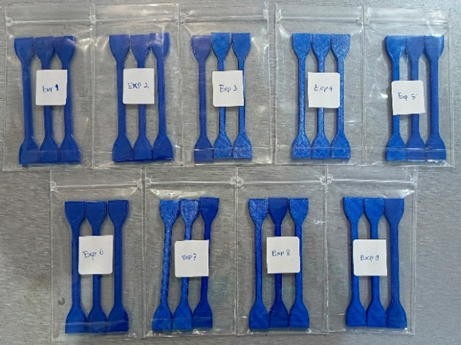
Penelitian ini bertujuan untuk menganalisis pengaruh variasi suhu nozzle dan ketebalan lapisan (layer height) terhadap kekuatan tarik material Polypropylene (PP) yang diproduksi menggunakan teknologi Fused Deposition Modeling (FDM). Metode Taguchi L9 Orthogonal Array digunakan untuk menentukan kombinasi parameter proses yang paling optimal dengan jumlah percobaan yang efisien. Pengujian kekuatan tarik dilakukan menggunakan Universal Testing Machine (UTM) berdasarkan standar ASTM D638-14 tipe IV. Hasil penelitian menunjukkan bahwa peningkatan suhu nozzle berpengaruh signifikan dalam memperkuat ikatan antar-lapisan, sehingga meningkatkan nilai kekuatan tarik material. Sebaliknya, peningkatan ketebalan lapisan menyebabkan penurunan sifat mekanik akibat lemahnya adhesi antar-layer. Kondisi optimum diperoleh pada suhu nozzle 250°C dan ketebalan lapisan 0,1 mm, dengan nilai kekuatan tarik rata-rata mencapai 55,7 MPa. Analisis Signal-to-Noise Ratio (S/N) menunjukkan bahwa suhu nozzle memberikan kontribusi dominan terhadap kestabilan dan kekuatan hasil cetakan. Secara keseluruhan, penelitian ini memberikan kontribusi terhadap optimasi parameter proses FDM berbasis material PP, terutama untuk mendukung peningkatan efisiensi dan performa mekanik pada aplikasi industri manufaktur aditif.
References
[1] Camposeco-Negrete, “Optimization of printing parameters in fused deposition modeling for improving part quality and process sustainability,” The International Journal of Advanced Manufacturing Technology, vol. 108, no. 7–8, pp. 2131–2147, 2020.
[2] V. Cojocaru, D. Frunzaverde, C. O. Miclosina, and G. Marginean, “The influence of the process parameters on the mechanical properties of PLA specimens produced by fused filament fabrication - A review,” Polymers, vol. 12, no. 4, p. 886, 2020.
[3] H. K. Dave, N. H. Patadiya, A. R. Prajapati, and S. R. Rajpurohit, “Effect of infill pattern and infill density at varying part orientation on tensile properties of fused deposition modeling-printed poly-lactic acid part,” Proc. Inst. Mech. Eng., Part C: J. Mech. Eng. Sci., vol. 235, no. 10, pp. 1811–1827, 2019.
[4] A. Díaz, J. Casas, L. Puigjaner, and A. Espuña, “Reducing diabetes work through 3D printing personalization,” Comput. Chem. Eng., vol. 155, p. 107513, 2021.
[5] N. A. Fountas, P. Kostazos, L. Pavlidis, V. Antoniou, D. Manolakos, and N. M. Vaxevanidis, “Experimental investigation and statistical modelling for assessing the tensile properties of FDM fabricated parts,” Procedia Structural Integrity, vol. 26, pp. 139–146, 2021.
[6] M. M. Hanon, R. Marczis, and L. Zsidai, “Influence of the 3D printing process settings effect on tensile strength of PLA and HT-PLA,” Period. Polytech. Mech. Eng., vol. 65, no. 1, pp. 38–46, 2021.
[7] F. Knoop, V. Schoeppner, and A. Schutte, “Influence of annealing on the mechanical properties of polypropylene components manufactured by fused filament fabrication,” Polymer Testing, vol. 108, p. 107519, 2022.
[8] M. A. Kumar, M. S. Khan, and S. B. Mishra, “Effect of machine parameters on strength and hardness of FDM printed carbon fiber reinforced PETG thermoplastics,” Mater. Today: Proc., vol. 27, pp. 975–983, 2021.
[9] S. Kumar and R. Singh, “Fabrication of biocompatible polypropylene/bio-glass scaffolds for bone tissue engineering applications using 3D printing technology,” Biocybern. Biomed. Eng., vol. 40, no. 4, pp. 1540–1555, 2020.
[10] J. Liao, N. Brosse, A. Pizzi, S. Hoppe, X. Xi, and X. Zhou, “Characterization and 3D printability of poly(lactic acid)/acetylated tannin composites,” Ind. Crops Prod., vol. 149, p. 112320, 2019.
[11] P. K. Mishra, S. Ponnusamy, and M. S. R. Nallamilli, “The influence of process parameters on the impact resistance of 3D printed PLA specimens under water-absorption and heat-treated conditions,” Rapid Prototyp. J., vol. 27, no. 2, pp. 283–294, 2021.
[12] M. A. Morales, A. Maranon, C. Hernandez, A. Porras, and J. A. Baena, “Development and characterization of a 3D printed cocoa bean shell filled recycled polypropylene for sustainable composites,” Polymers, vol. 13, no. 20, p. 3467, 2021.
[13] S. D. Nath, S. Nilufar, and S. V. Atre, “Effect of infill pattern and density on mechanical properties of 3D printed ULTEM 1010,” Procedia Manuf., vol. 53, pp. 718–728, 2021.
[14] T. D. Ngo, A. Kashani, G. Imbalzano, K. T. Nguyen, and D. Hui, “Additive manufacturing (3D printing): A review of materials, methods, applications and challenges,” Compos. Part B: Eng., vol. 143, pp. 172–196, 2018.
[15] D. Popescu, A. Zapciu, C. Amza, F. Baciu, and R. Marinescu, “FDM process parameters influence over the mechanical properties of polymer specimens: A review,” Polymer Testing, vol. 69, pp. 157–166, 2018.
[16] S. R. Rajpurohit and H. K. Dave, “Impact strength of 3D printed PLA using open source FFF-based 3D printer,” Prog. Addit. Manuf., vol. 4, no. 4, pp. 517–529, 2021.
[17] A. Rinanto, A. Nugroho, Y. Prasetya, and E. Pujiyanto, “Simultaneous optimization of tensile strength, energy consumption and processing time on FDM process using Taguchi and PCR-TOPSIS,” J. Tek. Ind., vol. 23, no. 1, pp. 1–12, 2021.
[18] Muhammad, A. R., et al. 2023. "Layer Height, Temperature Nozzle, Infill Geometry and Printing Speed Effect on Accuracy 3D Printing PETG,"R.E.M.(Rekayasa Energi Manufaktur), vol. 7, no. 2, 2023. DOI: https://doi.org/10.21070/r.e.m.v7i2.1649
[19] A. J. Sheoran and H. Kumar, “Fused deposition modeling process parameters optimization and effect on mechanical properties and part quality: Review and reflection on present research,” Mater. Today: Proc., vol. 21, pp. 1659–1672, 2020.
[20] Pristiansyah, P., et al. 2021 "Optimasi Parameter Proses Pencetakan 3D Printing terhadap Kebulatan Produk," J-Proteksion: Jurnal Kajian Ilmiah dan Teknologi Teknik Mesin, vol. 10, no. 1.
[21] Rakhmatov, V. B. B., Abdurashidkhon, A. A., and Azizbek, R, A. 2025. , "Fused Deposition Modeling (FDM) in Industrial Manufacturing: Challenges, Economic Aspects, and Prospects," Texas Journal of Engineering and Technology, vol. Vol. 42, pp. 20-23. DOI: https://doi.org/10.62480/tjet.2025.vol42.pp20-23
[22] R. Srinivasan, P. Prathap, A. Raj, S. A. Kannan, and V. Deepak, “Influence of fused deposition modeling process parameters on the mechanical properties of PETG parts,” Mater. Today: Proc., vol. 27, pp. 1877–1883, 2020.
[23] Abas, M., et al. 2022. "Parametric Investigation and Optimization to Study the Effect of Process Parameters on the Dimensional Deviation of Fused Deposition Modeling of 3D Printed Parts," Polymers, vol. 14, no. 17, p. 3667, DOI:https://doi.org/10.3390/polym14173667
[24] D. Yadav, D. Chhabra, R. K. Garg, A. Ahlawat, and A. Phogat, “Optimization of FDM 3D printing process parameters for multi-material using artificial neural network,” Mater. Today: Proc., vol. 21, pp. 1583–1591, 2020.
[25] Stojković, J. R., et al. 2023. "An Experimental Study on the Impact of Layer Height and Annealing Parameters on the Tensile Strength and Dimensional Accuracy of FDM 3D Printed Parts," Materials, vol. 16, no. 13, p. 4574, 2023. DOI: 10.3390/ma16134574
[26] Saputra, W. R., Suzen, Z. S., and Pristiansyah, P. 2023. “Pengaruh Parameter Proses terhadap Kuat Tarik Produk Hasil 3D Printing Menggunakan Filamen ASA (Acrylonitrile Styrene Acrylate),” J-Proteksion: Jurnal Kajian Ilmiah dan Teknologi Teknik Mesin, vol. 7, no. 2, pp. 73–78, DOI: https://doi.org/10.32528/jp.v7i2.9285
[27] O, Tunçel. Optimization of Charpy Impact Strength of Tough PLA Samples Produced by 3D Printing Using the Taguchi Method. Polymers, 16(4), 459 2024, doi: https://doi.org/10.3390/polym16040459.
[28] P. Pristiansyah, Ilham Ary Wahyudie, and R. Rosa, “Pengaruh Parameter Proses pada Pencetakan 3d Printing terhadap Transparansi Filamen Petg Menggunakan Metode Taguchi”, j-proteksion. j. kaji. ilm. dan. teknologi. teknik. mesin., vol. 9, no. 1, pp. 13–18, Aug. 2024, doi: https://doi.org/10.32528/jp.v9i1.1695.
Downloads
Published
How to Cite
License
Copyright (c) 2026 Pristiansyah Pristiansyah, Idola Brilian, Idiar Idiar

This work is licensed under a Creative Commons Attribution-NonCommercial-NoDerivatives 4.0 International License.
Addmenu

Dwonload


colaboration

Tools


Visitors
J-Proteksion: Jurnal Kajian Ilmiah dan Teknologi Teknik Mesin

J-Proteksion: Jurnal Kajian Ilmiah dan Teknologi Teknik Mesin is licensed under a Creative Commons Attribution-ShareAlike 4.0 International License. (CC - BY 4.0).